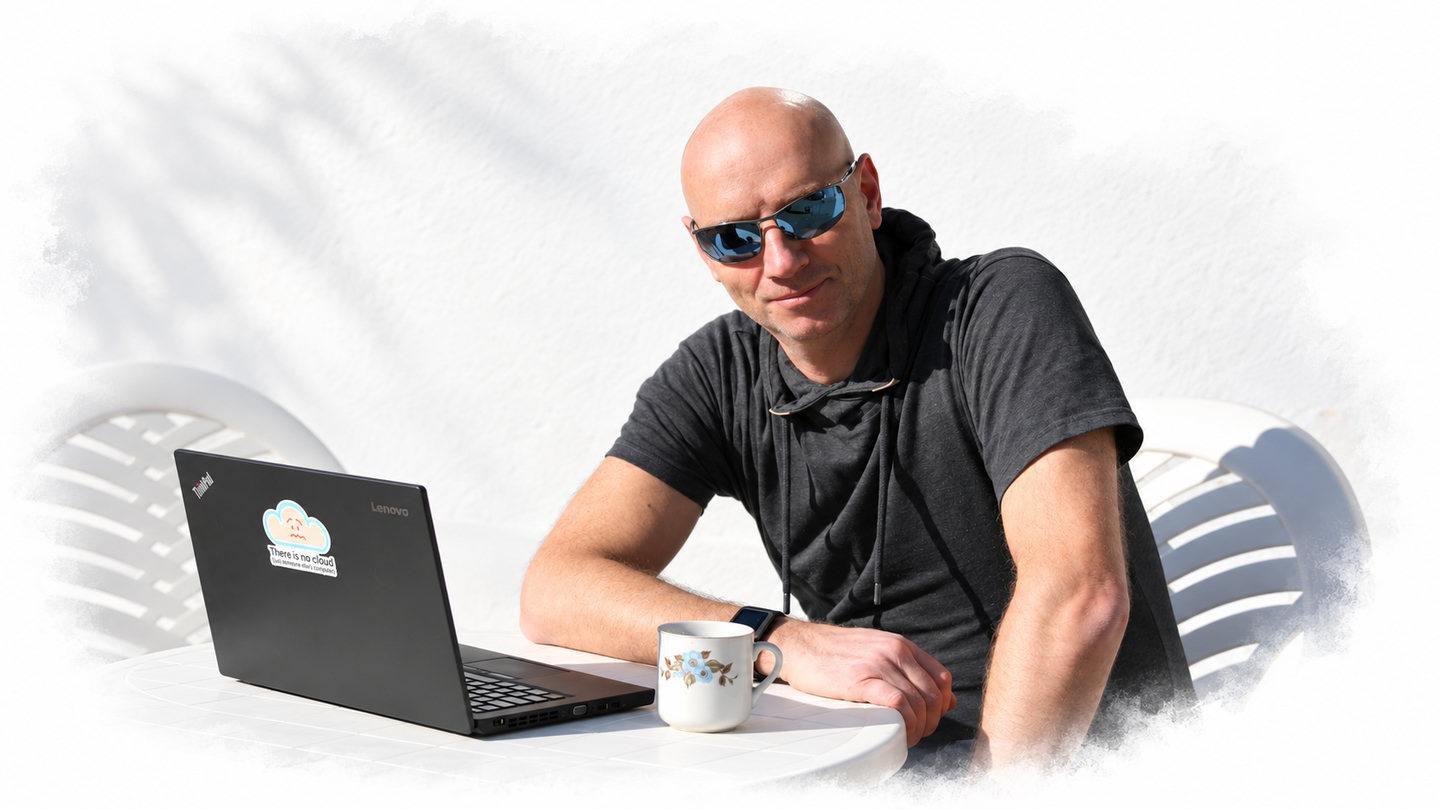
"Move fast and break it" works for some things. When you need to move fast without breaking it, then you need people who know what they are doing.
Hundreds of thousands of companies have used projects I have maintained or contributed to. One of my first commercial end users at my first startup in the 1990s was the US Air Force.
Today, I am an independent C++ developer and software architect.
I take on both short consulting assignments and longer development projects.
I have 40 years of experience in IT, mostly as a programmer (because I love it), but also in sales, management, IT security, sysops, DevOps and teaching. I have written more than 1 million lines of code by hand, primarily C and C++.
I have worked for tiny, small and large companies, startups and established businesses, both local and global.
I literally wrote the textbook on hardware used in Norway to educate IT technicians and other IT professionals.
What can I do for you?
Make you a new app or tool?
Take ownership of a hot project?
Fix something broken? Welcome to my software repair shop, where crashes, CPU and memory abuse go to die!
If you have been in IT for a while, there is a good chance that you have.
It started with my War FTP Daemon, which became quite popular in the late 1990s, and was used by lots of people and organizations, including NASA, numerous universities and many Fortune 500 companies. PHP still ships with an SMTP mail library I wrote back in the stone age. Since then, I have contributed to various open source projects, and I also worked briefly with the core of vCenter as a contractor at VMware.
Working with me
Engagements: Short-term troubleshooting, architecture consulting, and longer development contracts.
Collaboration: Independent ownership of an assignment, or working alongside an existing engineering team.
Current availability:Available
Client isolation: I use separate virtual machines to isolate client projects and prevent information leaks between clients or between clients and my own company.
Payments: Normally, I send an invoice, and you pay by bank transfer to my company's IBAN. For smaller assignments, I can also offer card payments through Stripe.
I work directly with my clients, without agencies or other intermediaries taking a cut. That means more of your budget goes toward actual engineering work.
Technologies
Some keywords from things I've designed and implemented over the years to give you an idea of what I can do.
Applications, Networking & SecurityQt desktop and mobile apps, privacy/Tor-enabled apps, VoIP, WebRTC, email, CMS, productivity apps, domain-specific applications, Web3, blockchain wallets, Ethereum and Bitcoin libraries, Windows installers, Word Processor, Multiuser BBS.
AI, Media & IntegrationsAI agents, MCP, audio and video processing, audio and video transcription, web scrapers, CGI, web server plugins, SOCKS proxies, REST client libraries, and much more...
Platforms
Platforms I have used.
Linux (since the 1990s), Mac (since the late 1980s), Windows (since version 2), Android (since version 1), iOS, QNX (versions 2–4), MS-DOS, NCR UNIX, SCO UNIX, Interactive UNIX, FreeBSD, Minix, Sintran, Digital VAX, CP/M.
Today, I use Linux for most work and Android for mobile apps.
Internet
I first got on the Internet in the late 1980s. I have implemented NNTP, SMTP, HTTP, DNS, POP3, SOCKS, SNMP, FTP, and NFS from scratch in C++.
I ported SSH and adns to Windows in 2000. I have written monitoring tools and many Internet-related libraries and applications.
Distributed systems
I designed and wrote 50% of a distributed word processor for QNX and UNIX in the early 1990s.
Since then I have worked on many distributed systems, including a California-based, globally distributed active/active NoSQL database SaaS.
Cloud
I wrote an early, generic orchestrator for AWS before Terraform was released. I also wrote a deployer for Kubernetes that could deploy complex systems in Kubernetes clouds and Minikube for individual developers, including ingress with TLS, automatic DNS configuration and certificate provisioning.
I have written C++ libraries for REST endpoints, proper JSON logging and metrics generation. Today I often use gRPC or mTLS for my cloud services.
C++ and other languages
I have used C++ as my preferred language since 1996. Besides C++, I have also used the languages below for work in the last few years.
Am I an expert on C++? No. The more I learn, the more I realize how much I still don't know or have forgotten.
World Wide Web
In 1997, I wrote a static web page generator in C++/MFC with a GUI. Microsoft released FrontPage using a similar approach at about the same time.
I have created web interfaces to servers, made a commercial CRM, automated website generators, web scrapers, HTTP servers and client libraries, plugins for Apache, Nginx, IIS, and PHP, and much more.
This site is built by my current static web site generator, stbl.
AI
AI has changed and continues to change everything.
My personal take is conflicted.
On one hand, I love the technology. I feel the same kind of enthusiasm and almost magnetic attraction towards AI today as I did with personal computers back in the 1980s and the Internet when it took off in the 1990s. The personal freedom to explore something genuinely new. The realization that I am part of a technical revolution that will change everything.
On the other hand, there is the negative impact it has on our lives, privacy, democracy and the economy. I definitely don't embrace techno-feudalism or deceptive marketing and targeted propaganda. Not to mention the existential threats of AI assisted hacking and autonomous AI worms.
Today I use AI a lot, both professionally and personally. I wrote my own agent in C++, using llama.cpp as a linked library to experiment with local models safely. And, of course, to dig a little deeper into how it actually works. I have also started adding MCP interfaces to some of my traditional applications, such as NextApp.
Open Source
Software development is my profession and also my greatest passion.
I have released many open source projects over the years. Every one of them was created to solve some need I had myself. The recent ones are on GitHub, but there are lots of older, now-obsolete projects scattered around on the Internet.
I learned programming by looking at and porting open source projects. To me it's a natural thing to contribute back my own code. Sometimes I even do parts of projects for customers for free, just so I can release that part (for example a library) as open source.
Privacy
My father realized the implications of IT and privacy back in the 1970s. In his 50s, this made him go back to the university in his spare time and study information technology and law. He missed no opportunity to lecture me, still a kid, about IT and privacy.
This has stuck with me ever since. I have always been an advocate for privacy and the use of cryptography to secure it. The open-source project I care most deeply about today is DarkSpeak, my secure instant messenger using the Tor network.
Security
IT security has always been very important. But today, it's mission-critical for any and all software projects. AI is getting really good at finding and exploiting zero-days everywhere.
I have had a strong focus on IT security since I started writing software. It's always at the forefront of my mind when I design and implement software systems.
I have designed and implemented a commercial firewall, trained office staff in IT security awareness, done penetration testing and safely and with their prior consent reproduced known vulnerabilities on clients' production servers to raise their awareness. All without AI. Today I also use AI to look for problematic code and vulnerabilities.
What I build today
I have completed many cool, challenging and even exhausting projects over the years. That's how I like it.
My focus is always on the future. I love to think genuinely new thoughts and explore new ideas. I can be extremely creative and productive - I even made my own frictionless Android dictation/transcription app just to capture new thoughts immediately when they appear.
I can't talk a lot about recent clients because of contracts and NDAs. But I can and do talk about my own projects.
NextApp is a modern desktop and mobile app written in C++20 with a Qt/QML user interface. It synchronizes data between devices in real time. The backend is written in C++ and supports multiple physical regions and integration with Stripe for payments. It's designed to handle many users on cheap cloud VM instances, keeping memory and CPU usage at a minimum. The build is split between GitHub Actions (backend container images, Linux Flatpak, and macOS) and Jenkins running locally (Android and Windows). It's deployed in staging and production with Ansible. In other words, I still design, build, deploy and maintain complete software systems, not just isolated components. I know where and how it hurts. NextApp
My AI agent can take a live dictation from me, run it through several models and produce a blog post, email or social media post in another language as output. QVocalWriter on GitHub
Vidpp can take an edited or raw video as input, add a hook banner and subtitles, edit out repetitions or silence and produce a video ready for platforms such as TikTok. vidpp on GitHub
nsBLAST is a DNS server that replicates the zones over gRPC streams to make changes in near real time. I wrote it in frustration over the slow replication that traditional DNS servers expose when you are in a hurry to create a new TLS certificate using DNS "proof" (for example wildcard certificates with Let's Encrypt). nsBLAST on GitHub
shared is an application that lets me copy files and clipboard text securely between my devices. This thing uses mTLS for authentication, a signed list of participants and their certs, and all traffic is P2P-encrypted (some packets may go via shared instances acting as relays between internal networks, and those don't need to see the content). shared on GitHub
You can look at my GitHub page yourself to see what public projects I currently play with.